Convert Pandas Dataframe to Numpy Array and Back Again
In this brusk Python Pandas tutorial, we will learn how to convert a Pandas dataframe to a NumPy array. Specifically, we volition learn how like shooting fish in a barrel information technology is to transform a dataframe to an array using the ii methods values and to_numpy, respectively. Furthermore, we will also learn how to import data from an Excel file and change this data to an array.
Now, if we desire to bear out some high-level mathematical functions using the NumPy bundle, we may demand to change the dataframe to a 2-d NumPy array.
Prerequisites
Now, if we want to convert a Pandas dataframe to a NumPy array we need to have Python, Pandas, and NumPy installed, of grade. Check the post about how to install Python packages to learn more well-nigh the installation of packages. It is recommended, even so, that we install Python packages in a virtual surround. Finally, if we install and download a Python distribution, nosotros will get everything we need. Dainty and easy!
How do yous convert a DataFrame to an array in Python?
To catechumen a Pandas DataFrame to a NumPy assortment() nosotros tin use the values method (DataFrame.to_numpy()). For instance, if we want to convert our dataframe called df we tin add this code: np_array = df.to_numpy().
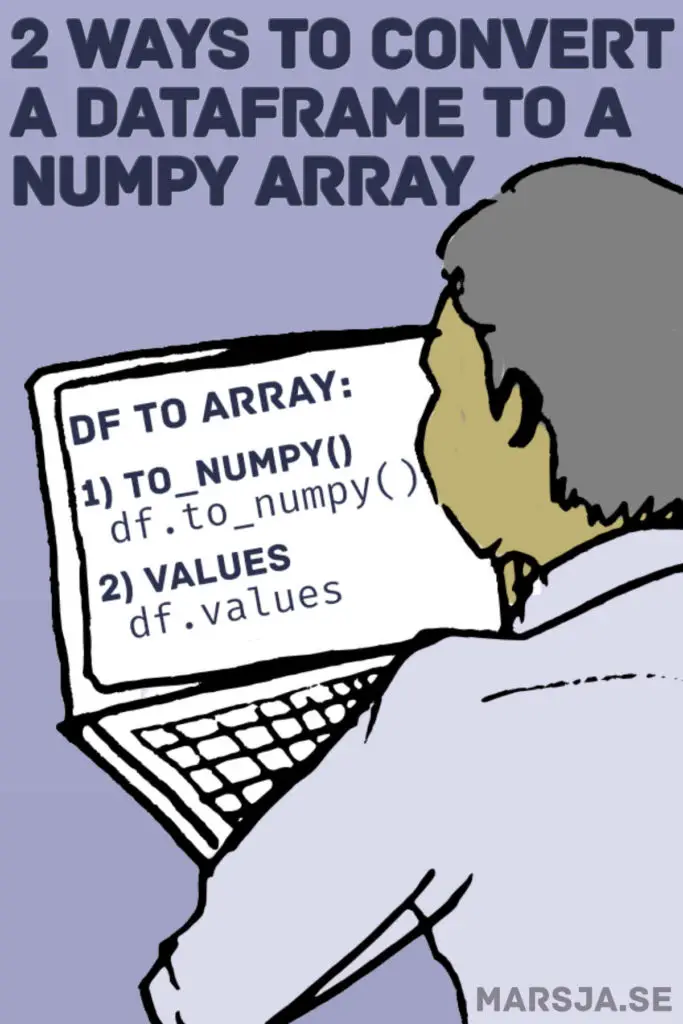
How to Convert a Pandas Dataframe to a Numpy Array in 3 Steps:
In this section, nosotros are going to three like shooting fish in a barrel steps to convert a dataframe into a NumPy array. In the kickoff step, we import Pandas and NumPy. Step 2 involves creating the dataframe from a dictionary. Of form, this step could instead involve importing the data from a file (eastward.thou., CSV, Excel). In the final step, we volition use the values method to get the dataframe equally an array.
Step #1: Import the Python Libraries
In the first example of how to convert a dataframe to an array, we will create a dataframe from a Python dictionary. The first step, however, is to import the Python libraries we need:
import pandas equally pd import numpy as np
Lawmaking language: Python ( python ) At present, we followed the the convention and imported pandas equally pd and NumPy equally np. In the next step, we will get the data. This step, of form, is optional if you already accept your information in Pandas dataframe. If this is the case, you can skip to the third step and just goahead and convert the dataframe to NumPy assortment.
Stride #ii: Get your Information into a Pandas Dataframe
In the second pace, we will create the Python dictionary and convert it to a Pandas dataframe:
data = {'Rank':[1, ii, iii, four, 5, 6], 'Language': ['Python', 'Java', 'Javascript', 'C#', 'PHP', 'C/C++'], 'Share':[29.88, 19.05, 8.17, 7.iii, 6.15, 5.92], 'Tendency':[four.i, -one.8, 0.ane, -0.ane, -ane.0, -0.2]} df = pd.DataFrame(data) brandish(df)
Code language: Python ( python ) 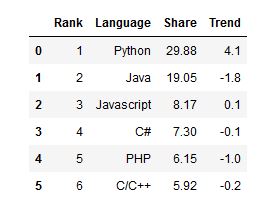
As yous may empathize, this step is optional, and you can of course import information from a .csv, SPSS, STATA, Excel, or Stata file, to name a few, instead. Furthermore, check the mail nearly how to catechumen a dictionary to a Pandas dataframe for more data on creating dataframes from dictionaries. In the next step, we are ready to change the dataframe to an array.
Pace #3 Catechumen the Dataframe to an Array:
Finally, in the third step, we are ready to utilize the values method. Here's how to convert the Pandas dataframe to a NumPy array:
# convert dataframe to numpy array df.values
Code language: Python ( python ) 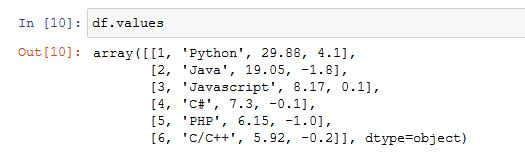
That was easy, using the values method nosotros converted the Pandas dataframe to a NumPy array in one line of code. In the next example, nosotros are going to work with another method. That is, we are going to use the recommended to_numpy() method.
How to Change a Dataframe to a Numpy Assortment Example 2:
In the second example, we are going to catechumen a Pandas dataframe to a NumPy Array using the to_numpy() method. At present, the to_numpy() method is as simple as the values method. However, this method to convert the dataframe to an array can also take parameters.
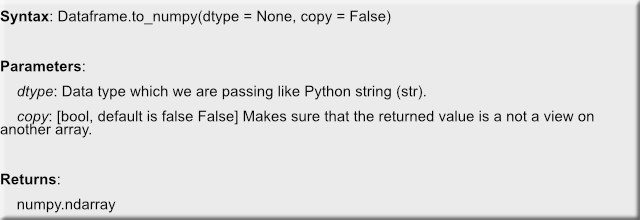
Catechumen Pandas to a NumPy Array with to_numpy()
At present, here's a elementary conversion example, generating the same NumPy array every bit in the previous the case;
# Pandas dataframe to numpy array: df.to_numpy()
Code language: Python ( python ) Convert a Pandas Column Cavalcade with Floats to NumPy Assortment
If we want to convert just one cavalcade, we tin use the dtype parameter. For instance, here we will convert one cavalcade of the dataframe (i.east., Share) to a NumPy array of NumPy Bladder data type;
# pandas to numpy just floating-signal numbers: df['Share'].to_numpy(np.float64)
Code linguistic communication: Python ( python ) 
Annotation, if we wanted to convert only the columns containing integers we tin can utilise no.int64. For strings, nosotros could input object. A concluding note, before going to the tertiary example, is that is recommended to convert Pandas dataframe to an array using the to_numpy() method. In the next case, we are going to simply select float and then catechumen the columns containing float values to a NumPy array.
Catechumen only Pandas Float Columns in a Dataframe to a NumPy Array Example three:
At present, if we merely want the numeric values from the dataframe to be converted to NumPy assortment information technology is possible. Here, we need to use the select_dtypes method.
# Pandas dataframe to NumPy array selecting specific information types: df.select_dtypes(include=float).to_numpy()
Code language: Python ( python ) 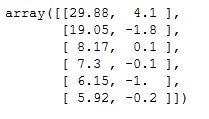
Note, when selecting the columns with float values nosotros used the parameter float. If we, on the other mitt, want to select the columns with integers we could utilize int. Using this argument comes in handy when we want to e.k. calculate descriptive statistics or just desire to extract certain information types from the NumPy array.
Read an Excel File to a Dataframe and Convert information technology to a NumPy Array Example iv:
Now, of course, many times we have the information stored in a file. For instance, nosotros may desire to read the data from an Excel file using Pandas then transform it into a NumPy 2-d array. Here's a quick an example using Pandas to read an Excel file:
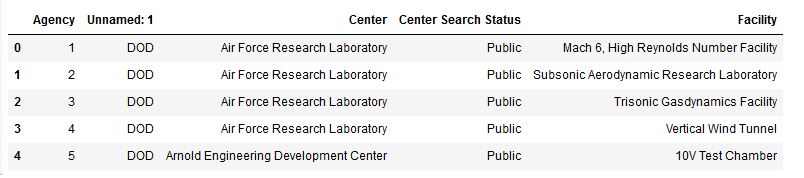
# Reading the excel file df = pd.read_excel('http://open up.nasa.gov/datasets/NASA_Labs_Facilities.xlsx', skiprows=i) # Exploring the offset v rows and columns: df.iloc[0:5, 0:5]
Lawmaking language: Python ( python ) Now, in the lawmaking, above we read an Excel (.xlsx) file from a URL. Here, the skiprows parameter was used to skip the first empty row. Moreover, we used Pandas iloc to piece columns and rows, from this df and print it. Here'southward the consequence:
In the last instance we volition, again, use df.to_numpy() to convert the dataframe to a NumPy array:
# Converting the dataframe to an assortment: np_array = df.to_numpy()
Code language: Python ( python ) 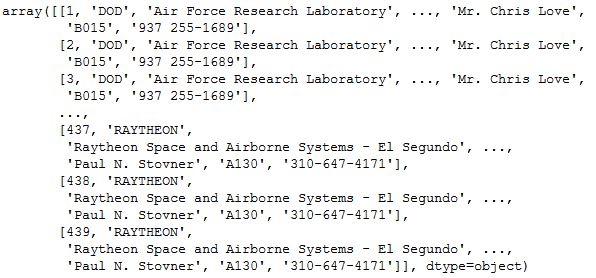
Converting a Pandas dataframe to a NumPy array: Summary Statistics
In this last department, we are going to convert a dataframe to a NumPy assortment and use some of the methods of the array object. Again, we start by creating a dictionary. Second, we use the DataFrame class to create a dataframe from the lexicon. Finally, we convert the dataframe to a NumPy array but selecting bladder numbers.
# Creating a dict data = {'Rank':[i, 2, three, iv, 5, 6], 'Linguistic communication': ['Python', 'Coffee', 'Javascript', 'C#', 'PHP', 'C/C++'], 'Share':[29.88, 19.05, 8.17, 7.3, half-dozen.15, 5.92], 'Trend':[4.1, -1.8, 0.1, -0.1, -one.0, -0.two]} # Creating a dataframe from dict df = pd.DataFrame(information) # Pandas to NumPy np_array = df.select_dtypes(include=float).to_numpy()
Lawmaking language: Python ( python ) Now that we have our NumPy array we can start using some methods for computing summary statistics. First, we are going to summarize the two dimensions using the sum() method. Here's an instance code snippet:
# Summarizing the array np_array.sum(axis=0)
Code linguistic communication: Python ( python ) Second, we can summate the mean values of the ii dimensions using the mean():
# Calculating the mean of the array: np_array.hateful(axis=0)
Code language: Python ( python ) Notation, that nosotros used the parameter centrality and set it to "0". Now, if nosotros didn't employ this parameter and set it to "0" nosotros would have calculated information technology along each row, sort of speaking, of the assortment. This may be useful if we wanted to summate the hateful of scores across each observation in the dataset, for instance. For case, if nosotros have information from a questionnaire thought to mensurate different constructs, nosotros may desire to create a summary score for the complete scale (also as for the constructs). In this example, we would remove the centrality parameter.
DataFrame to Assortment YouTube Tutorial
Here's also a YouTube Video explaining how to convert a Pandas dataframe to a NumPy array:
Conclusion
In this Pandas dataframe tutorial, we take learned how to convert Pandas dataframes to NumPy arrays. Information technology was an easy task and nosotros learned how to practice this using valuesouth and to_numpy. As a final note, and as previously mentioned, y'all should employ the later method for converting the dataframe.

Source: https://www.marsja.se/how-to-convert-a-pandas-dataframe-to-a-numpy-array/
0 Response to "Convert Pandas Dataframe to Numpy Array and Back Again"
Post a Comment