Philly economic stakeholders need to start organizing right now
Nov. xvi, 2020


 Every bit our nation turns its weary and anxious optics away from the election, we are thinking hard about what comes next. We are entering into ane of the worst phases of the Covid-19 pandemic with massive uncertainty almost what type of stimulus volition come up and when.
Our bulletin hither is a simple ane: Local economic stakeholders cannot afford to await to proceed until the federal fog of uncertainty lifts. They must start organizing now.
Equally we wrote in early April, local economies did not have the luxury of waiting for federal action on modest business relief. Today's state of affairs is similar, but dissimilar in one cardinal respect: rather than just emergency relief, what'south at stake is a recovery that volition shape the next decade (and longer) for local economies.
In March, local stakeholders across the country ready up local small business relief funds before the federal government could act. Today, action is needed on a vaster scale which organizes public, private, and philanthropic stakeholders locally to provide versatile channels for directing resources for a recovery—regardless of where the federal government settles.
Below nosotros provide a review of the federal post-ballot dubiety and the beginning stages of a local roadmap for how to organize through this doubt and maximize the bear upon of the recovery.
Nosotros believe that small-scale business will be ane of the earliest, virtually emblematic, and almost of import, sources of recovery capital. It is likewise a domain where local stakeholders have a better view of the situation and where many of the deportment are valuable even in the absenteeism of federal funds. Federal funds are not the only game in town either: Private funds can exist utilized here too.
Indeed, we are already seeing philanthropic capital from large companies like JP Morgan Hunt, Bank of America, Verizon, and Netflix to address the crunch facing Black- and Latino-endemic businesses. Equally a result, small business should be a top metro recovery priority that serves as a model for subsequent efforts.
(Note: We are working with Accelerator for America and Mastercard's Center for Inclusive Growth to create a template for recovery playbooks; more to come by January.)
New localism in a fog of federal doubt
Assuming office in January, the incoming Biden-Harris Administration will exist handed "a hot American mess" every bit Axios puts it. They volition be tasked with solving the four intersecting crises of public health, race, the economy, and climate alter that our securely polarized country is currently wrestling with.
On acme of this, it'south not yet clear who volition command the senate. This will be decided by two runoff elections in Georgia on January 5. If Democrats sweep, nosotros are looking at a likely large stimulus driven by a push-and-pull between the Left and Eye of the Democratic Party; if Republicans hold the majority, we're looking at divided authorities and questions nearly whether the federal response will be acceptable to the depth of the downturn.
On height of this, it is uncertain what the lame-duck session before inauguration holds. The Trump Assistants is preoccupied with its quixotic pursuit of overturning election returns and has brought many GOP leaders into the fray.
It has delegated stimulus efforts to Majority Leader Mitch McConnell, who has expressed interest in passing a bill before January. Speaker Pelosi has too expressed a want for additional relief, only information technology's unclear if they'll be able to attain a deal.
The Biden-Harris Transition Team is as well starting conversations this week with the Autonomous leadership to advance their priorities in a coming stimulus.
In short, the Hill is steeped in a fog of uncertainty that volition articulate in one of four ways. Yet information technology's not still obvious which upshot is the most likely:
- A lame duck stimulus in December followed by a small countercyclical package in February
- No lame duck stimulus and a small-scale countercyclical bundle in February
- No lame duck stimulus and a large countercyclical bundle in February, or
- A lame duck stimulus in December followed past a large countercyclical bundle in February.
In brusk: Information technology is unclear when the federal cavalry is coming and what size it volition be when it arrives. Amidst this federal uncertainty, local stakeholders must seize the reins of their economic destiny.
In the still-possible case of a divided government, local organization is non merely an choice, it is a necessity. Even in the most ambitious of federal recovery packages, nosotros would propose local leaders organize to maximize the touch on of a recovery.
The fundamental lesson we learned from the 2009 Recovery Act is that the places with organized local leaders were able to direct locally transformational federal investments: Chattanooga, TN, for case did merely this and leapt ahead in high speed internet and clean electricity.
Local leaders should organize effectually 3 goals to ensure a transformative recovery: (1) harnessing the total energies of the local; (2) beingness flexible to enable alignment between federal and local priorities; and (3) edifice chapters locally. To actualize these goals, they should follow the roadmap below.
What should local stakeholders do?
A local roadmap to seize this moment
The inclusive development of metro economies is an inherently complex, multi-disciplinary, cross sector challenge. This is peculiarly truthful in a recession and even more-then during a pandemic.
Ongoing attempts to advance the economic prospects of places can originate from i-or-all of many institutions: anchor corporations, business leadership groups, universities and hospitals, metropolis governments, city or state economical development entities, metropolitan planning organizations, quasi-public authorities, community organizations, and more.
Calculation to the complexity, well-intentioned actors must navigate federal, land, county, and local politics and programs.
To date, unifying entities that bring the entirety of a metropolis's capabilities to bear for its economic development take been few and far between. Recent years take presented a glimpse of what cities are capable of when they bring central stakeholders together to maximize the impact of an exogenous opportunity.
 In 2017, Amazon gear up off a historic frenzy by announcing their intention to open a new headquarters, dubbed HQ2. So, in Dec of the same year, the Tax Cuts and Jobs Human activity created the Opportunity Zones incentive, which encouraged investment in distressed neighborhoods.
While not without controversy, these two occurrences spurred cities to organize and communicate their strengths, and in and then-doing brought near cross-sector collaboration through the development of creative pitches and investment prospectuses.
Local stakeholders would exist wise to view the coming relief and recovery bundle is the well-nigh of import public investment in metro economies in this decade. They should have the lessons of the previous three years to organize themselves effectually a program to maximize the touch of the COVID-19 relief and recovery spending.
This is an "HQ2 moment" regardless of the size of the federal stimulus. At stake is cipher less than the strength of local economies for the adjacent decade or more than.
Nosotros recommend that coalitions of local stakeholders have the post-obit five actions to seize the moment:
How coalitions of local stakeholders can seize this moment
Immediately Stand Up A Metro Recovery Task Force
In lodge to constitute a clear fix of plans and priorities and to maximize the speed and effectiveness of the mail service-COVID recovery, we recommend that every major metro immediately stand upward an executive-level task strength with leaders from the public, private, and civic sectors that has a rapid-response "state of war room" focused on the recovery. Many cities, such as St. Louis, have done this for public wellness. This arrangement can serve as a model for the economic recovery.
This job force must complete four deliverables, outlined below, past no-later than belatedly Jan 2022 when the initial federal relief package is expected to be passed. At a minimum a metro chore forcefulness should designate local leaders to guide planning and gather intelligence around these four components:
- Setting Local Priorities for Key Areas of Economical Recovery: Cities need to declare their distinctive priorities in each of 4 core economic recovery categories: innovation, infrastructure, minor business, and workforce. These priorities should be shaped past an evidence-driven view of local challenges and opportunities.
- Empathise Federal Investments: Cities need to empathize federal priorities and agency spend categories and position metro priorities appropriately. Nosotros elaborate below.
- Build Readiness Teams: Cities should focus on edifice capacity across local institutions and practitioners to ensure that federal funds tin can be delivered in an efficacious, fair, rapid manner.
- Engage communities: Cities and local leaders should focus on building channels to communicate to local residents to ensure transparency and date with the procedure throughout.
How information technology's happening for small concern: As we recently wrote in our Big Ideas for Small Business report, pocket-sized businesses flourish with the back up of institutions designed to maximize procurement demand, financing, counseling, market place-making, business districts, and other services.
Federal programs are a compliment to, rather than a substitute for, a stiff local ecosystem of incubators, Community Development Financial Institutions (CDFIs), public development corporations, Chambers of Commerce and other organizations.
Federal programs have the greatest touch on when they work with local organizations that can assistance small businesses admission federal resources and leverage federal dollars through additional public and individual investment.
Not all regions of the country benefit from the same quantity or quality of these ecosystem-building institutions. Some metropolitan areas like Los Angeles and Philadelphia, for example, accept a potent network of CDFIs, which has enabled them to design and deliver special initiatives that are tailored to particular communities or segments of the business customs. But many other areas do non take this.
To best support small businesses, nosotros recommend that local job forces and ecosystems take six actions we highlight in our Big Ideas for Pocket-sized Businesses report—prioritizing community engagement throughout—including:
- Maintaining real-fourth dimension information on the number, size and sector of small businesses in full general and minority and women-owned business enterprise (MWBE) in particular;
- Routinely collecting data, set goals and publicly report progress on the procurement spend of big "anchor institutions" from minority- and women-owned businesses;
- Identifying, nurturing, mentoring, and supporting firms to develop intentional business strategies and proceeds access to the network of providers that offer the about upwardly-to-date data on such practices every bit accounting, borrowing, leasing, legal, taxation, hiring, technology, marketing and client and supplier relationships
- Providing access to high-quality, affordable, and responsible capital letter beyond a wide continuum that is aligned with the needs of minor businesses at dissimilar stages of their lifecycles and in disparate sectors;
- Managing and marketing business organization districts and commercial corridors where many pocket-sized businesses congregate and co-locate; and
- Fostering peer-to-peer networks among small-scale-business owners and entrepreneurs to share resource and advice, serve every bit prospective buyers of other local businesses, and build collective action to inform and influence ecosystem strategies and initiatives.
Clearly Outline Metro Plans and Priorities
By January, 2021, the Task Force should know and position metro priorities effectually a key recovery narrative and actions in a short memo that will deed as the ultimate guidance for local plans developed and federal asks that are made.
It's probable that recovery spending will showtime move to small business concern recovery—post-obit which it volition move to a combination of infrastructure, innovation, and workforce/human capital. These spend categories are likely to be widely distributed across federal agencies, programs, and products. We recommend organizing for minor business first and using that feel to shape subsequent metro plans and priorities in other spending categories.
The City Job Strength should liaise with leaders and the customs to develop a certificate that conspicuously articulates the highest local priorities and visions, while positioning them within probable countercyclical spend categories. Drafters should pay special attention to how these priorities respond to likely spend categories, agencies, and products. Crucially, organizing yourself around cardinal recovery categories is not just nearly getting more than federal resources, information technology is about using them to greater impact by leveraging them with private resources.
It is imperative that local coalitions organize to navigate the boundless array of federal funds—loan products, tax incentives, competitive grants, cake grants—and agencies. Recovery funding will be multi-sectoral and multi-dimensional. The best organized localities volition be the best positioned, regardless of what happens in DC. Already some local coalitions in Chicago, Cleveland, Kansas City, Philadelphia, St. Louis and San Jose are orienting recovery plans around key priorities similar innovation and small-scale business.
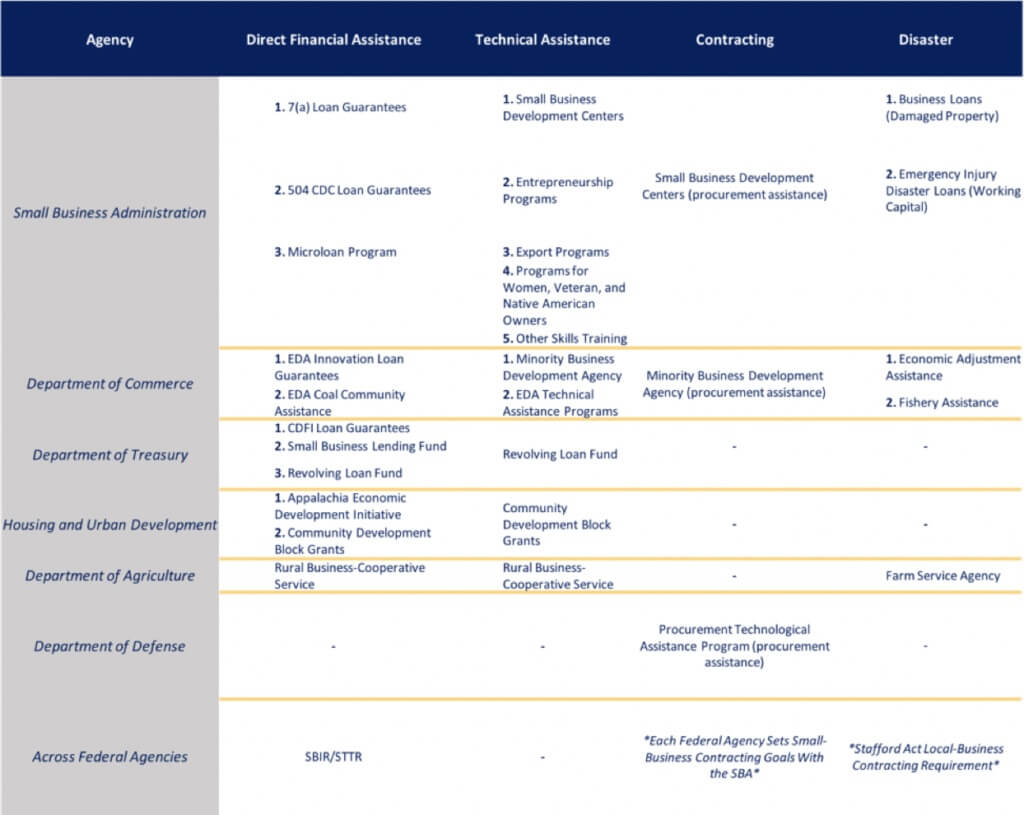
How it's happening for small business organization: The Federal landscape of pocket-sized business organisation support is emblematic of this matrix. Prior to COVID-19 information technology was equanimous by 31 separate funding streams, distributed across four product-types and half-dozen federal agencies (with additional cross-agency initiatives).
The pandemic response has created a second overlay of new products. Information technology's likely that small business relief funding will come through modest increases of funding to these existing channels alongside COVID-specific products like a revised Paycheck Protection Program. Nosotros recommend that local chore forces accept clear plans to navigate this assortment of possibilities along with guidance for metro stakeholders.
In the case of small business organization, this involves building a business ecosystem that can harness and leverage federal resources and engage with communities excluded from previous rounds of support—and this design repeats across all major recovery spending types.
Designate Your Local-to-Federal Liaison
Past January, 2021, the Task Force should designate a federal liaison as the go-betwixt to Washington. Competition is likely to be intense for express federal resources. This is especially true if we are in a situation of divided government. Having a plan to navigate the landscape is the first footstep, merely metros that have a designated federal liaison will benefit immensely.
This liaison should empathize the ins-and-outs of different federal agencies equally well an agreement of metro priorities, and a good sense of the different financing products that the federal authorities uses. They should be the key conduit for locals to button for flexibility in federal-to-local products equally well as to highlight the mode local priorities fit within the Biden-Harris Assistants's goals.
Constitute a Local Coordinating Intermediary for Fair and Effective Fund Deployment
By January, 2021, the Job Force should plant a local funding coordination entity to maximize local employ of federal relief and recovery dollars. In the by, one of the biggest issues for metro economies trying to use relief and recovery bills is that countercyclical funds take been obligated but not deployed.
 This was true of weatherization and infrastructure money in the 2009 recovery human activity, and it is currently true of money in the CARES Coronavirus Relief Fund. In general, it is too true that the federal funds that are most efficiently deployed are those which run through existing federal funding channels. The lesson here is that funds volition be deployed effectively if in that location is clear guidance and local knowledge and capacity.
A key manner to build this local knowledge and chapters is to establish or support a local intermediary through the Task Strength that can be a "clearinghouse" to understand what federal funds can exist used for what local projects and tin can ensure disinterestedness across neighborhoods in the process. It is difficult to establish 1 of these from scratch.
We recommend establishing a local intermediary that coordinates existing efforts that are already underway to both avert reinventing the wheel and to present a locally "unified front" when finer deploying money.
How it's happening for small business: We have been working closely with a group of cross-sector local leaders in Cincinnati to establish the Cincinnati Regeneration Alliance (modeled off our telephone call for Main Street Regenerators).
The Brotherhood, once established, will represent a coordinating council made upwardly of representatives from key community and business organisation organizations to ensure that the small business recovery is geographically fair and that the city is utilizing its Coronavirus Relief Fund money effectively.
The Alliance would have vii core functions that volition exist carried out over its 36 month lifespan:
- Leveraging anchor procurement
- Supporting Black-owned business
- Maximizing real estate usage
- Increasing access to capital
- Driving quality place making
- Diminishing the impact of the parasitic economy
- Building wealth
Establish a Local Fund Leveraging Intermediary
By January, 2021, found an intermediary to leverage local sources of capital with federal spending. Final, merely definitely not least, given the probability of a skinny stimulus, local governments should brand every effort to leverage federal public money with private capital.
This will not happen by itself. It will take dedicated work and an intermediary to coordinate efforts, engage the community, and attract upper-case letter. As was truthful for economic development initiatives of the last few years, local intermediaries will be essential to getting the task done hither.
The places that have more capable local intermediaries to blend public and private money will exist able to have a larger affect in their recovery. On top of this, they will be more apt to become greater public and individual investment.
Nosotros recommend that the Task Strength takes steps to establish a local fund-leveraging intermediary as soon as possible. This can be a function of, or separate from, the coordinating intermediary described above.
How it's happening for small business: The Detroit Strategic Neighborhood Fund, is a funding source that draws from bank and philanthropic contributions and public subsidies to improve Detroit neighborhoods. It is managed past a CDFI, Invest Detroit, which also takes the lead on fundraising.
In 2016, the fund raised $30-42 million to target 3 neighborhoods. In each of the three neighborhoods, it activated an eight to twelve block Microdistrict to support gap-financing for evolution projects.
Then far, funding for the three neighborhoods has been used for tax credits toward affordable housing in the Islandview-Greater Villages area and kickstarting the Fitzgerald neighborhood project, which includes renovating several homes owned by the Detroit Land Bank Say-so, and crafting a new greenway throughout the neighborhood.
In 2018, it raised $130 million for seven boosted neighborhoods. Funders include a wide range of public and philanthropic funders (notably the CDFI Fund and JP Morgan Hunt). Models similar the Strategic Neighborhood Fund will be vital to make the most of federal stimulus.
The path ahead
In our estimation, the recovery from Covid-19 amidst the country's current partitioning—and a potentially divided government–– is going to make it ane of the well-nigh difficult and fraught recoveries since the Great Low. Getting this land dorsum on track will take everything we take from the federal and government, state governments and local networks. Chiefly, information technology volition crave local networks organizing themselves right now to effectively distribute stimulus money. Fifty-fifty in the event of a skinny stimulus, this arrangement volition pay dividends since the local infrastructure will serve every bit a key way for attracting and leveraging investments from individual and philanthropic actors. At that place's a lot of dubiousness on the loma right now, the one certainty is that it's not but an selection for cities to organize, it is a necessity.
Bruce Katz is the founding director of the Nowak Metro Finance Lab at Drexel University. Colin Higgins is a senior research fellow at the Lindy Plant at Drexel University, which houses the Nowak Metro Finance Lab.
Photo courtesy Katherine Rapin 
Source: https://thephiladelphiacitizen.org/organizing-for-uncertainty/
0 Response to "Philly economic stakeholders need to start organizing right now"
Post a Comment